Maybe It's Okay To Be A Social Insect?
There’s a common argument in wild animal welfare circles that most animal lives are not worth living. Many kinds of animals have hundreds if not thousands of offspring. On average, if the population is stable, only two of those offspring can survive long enough to reproduce.
That implies two things about wild animal welfare. First, most animals don’t live long enough to have children, which means that they’re not alive for very long. That means a relatively high percentage of their life is spent going through the very unpleasant process of dying. For example, a common housefly that dies when it is a maggot may have only been alive for a day; if it takes an hour to die, then five percent of its life is spent dying. If a human takes an hour to die, then the amount of time they spend dying is so small my calculator writes it with scientific notation.
Second, the vast majority of animals are not reproductively successful. This is a vast overgeneralization with many exceptions, but in general, in the environment of evolutionary adaptedness, you can expect animals to have evolved to be happy when they have experiences positively correlated with reproductive success and unhappy when they have experiences negatively correlated with it. Therefore, we can guess that the average wild animal probably experiences more negative experiences (hunger, fear, exposure to heat or cold, disease) and fewer positive experiences (sex, being adequately fed).
Now, these are very theoretical arguments, and have not been backed up with solid empirical work, in part because the field is in its infancy and the subject just hasn’t been studied. You can imagine situations where these arguments don’t hold: for example, maybe the average maggot lives a very happy maggot life before it is quickly and painlessly eaten by a bird. But I do think that, before we look at the evidence, we can expect most individuals of most species to be more unhappy than happy.
However, I have another theoretical objection: social insects.
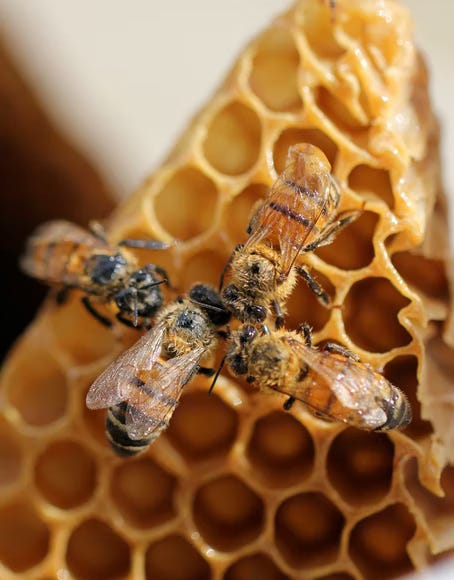
In social insects, the unit of selection is not the individual, but the colony. Only the queen (usually) reproduces. That means that the above argument doesn’t hold. Most colonies fail, but because they fail, very few individuals live in them. We can expect individuals to disproportionately live in the most successful colonies. In fact, if colony success is a power-law distribution, we can expect the vast majority of individuals to live in the most successful colonies!
To the extent that animals are happy when they have experiences correlated with reproductive success, we should expect the average ant or bee to actually be pretty happy. Successful colonies are more likely to have adequate food and to be safe from disease and predation, so we should expect the average social insect to be more likely to be well-fed and safe.
Furthermore, we don’t know that bees or ants necessarily die young. As far as I can tell, no one has researched the average lifespan of an ant or a bee, as opposed to their maximal lifespan. But there would be nothing odd about the average ant or bee having a lifespan that is relatively close to the maximum for their species. We can guess that the average housefly doesn’t live long enough to reproduce, but an ant or bee isn’t going to reproduce anyway, so we have no information about how long their lives are.
My argument here points to some important directions for future research:
-
Are social insects more likely to be sentient than other species of insects? Preliminary research suggests maybe, especially for honeybees. If some species of social insects were sentient but other insects weren’t, that would be good news.
-
What is the life of a member of a social insect species like? How long do they live? How much time do they spend hungry, sick, injured, cold? Of course, it is intractable to study this for every species, but researchers could look at representative species.
-
If e.g. honeybees are sentient and happy, under certain assumptions about population ethics, it would be good if there were more honeybees. How can we cause this to happen?
-
Almost none of the theoretical and empirical work has been done to make this possible, but in principle you could figure out how much we should value social insect lives versus other animal lives and how many individuals are social insects. I think that, based in part on this argument and under some plausible assumptions, wild animals are more likely to have happy lives than unhappy lives.