Underdog Overdrive
First, a PSA:
In keeping with my apparent ongoing role as The Guy Who Keeps Getting Asked to Talk About Subjects In Which He Has No Expertise (and for those of you who didn’t see the Facebook post), The Atlantic solicited from me a piece on Conscious AI a few months back. The field is moving so fast that’s it’s probably completely out of date by now, but a few days ago they put it out anyway. (Apologies for the lack of profanity therein. Apparently they have these things called “journalistic standards”.)
And Now, Our Feature Presentation:
I am dripping with sweat as I type this. The BUG says I am as red as a cooked lobster, which is telling in light of the fact that the game I have been playing is the only VR game in my collection that you play sitting down. It should be a game for couch potatoes, and I’m sweating as hard as if I’d just done 7k on the treadmill. And I still haven’t even made it out of the Killbox. I haven’t even got into the city of New Brakka yet, and until I can get into that EM-shielded so-called Last Free City, the vengeful-nanny AI known as Big Sys is gonna keep hacking into my brother’s brain until it’s nothing but a protein slushy.
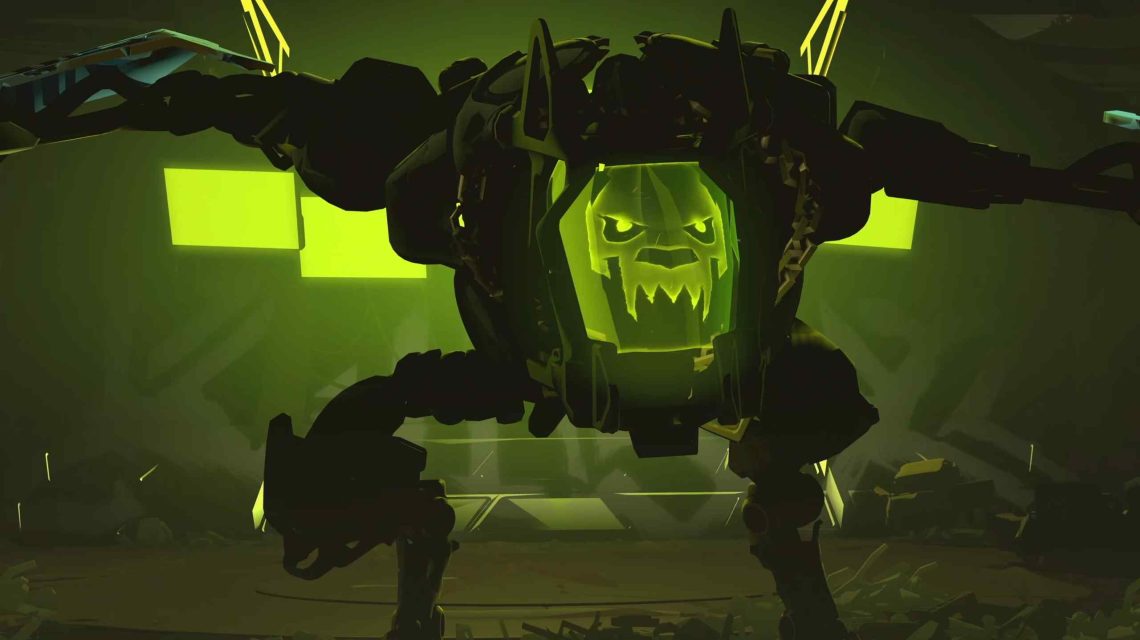
The game is Underdogs, the new release from One Hamsa, and it has surprisingly deep lore for a title that consists mainly of robots punching each other in the face. I know—even though I’ve encountered very little of it in my playthroughs so far—because I wrote a lot of it. After a quarter-century of intermittent gigs in the video game business, on titles ranging from Freemium to Triple-A, this is the first time I’ve had a hand in a game that’s actually made it to market (unless you want to count Crysis 2—which, set in 2022, is now a period piece— and for which I only wrote the novelization based on Richard Morgan’s script.)
Underdogs is a weird indie chimera: part graphic novel, part tabletop role-play, part Roguelike mech battle. It’s that last element that’s the throbbing, face-pounding heart of the artifact of course, the reason you play in the first place. You climb into your mech and hurtle into the KillBox and it’s only after an hour of intense metal-smashing physics that you realize you’re completely out of breath and your headset is soaked like a dishrag. The other elements are mere connective tissue. Combat happens at night; during daylight hours you’re hustling for upgrades and add-ons (stealing’s always an option, albeit a risky one), negotiating hacks and sabotage for the coming match, getting into junkyard fights over usable salvage. Sometimes you find something in the rubble that boosts your odds in the ring; sometimes the guy hired to fix your mech fucks up, leaves the machine in worse shape than he found it, and buggers off with your tools. Sometimes you spend the day desperately trying to find parts to fix last night’s damage so you won’t be going into the ring tonight with a cracked cockpit bubble and one arm missing.
All this interstitial stuff is presented in a kind of interactive 2.5D graphic novel format; the outcomes of street fights or shoplifting gambits are decided via automated dice roll. Dialog unspools via text bubble; economic transactions, via icons and menus. All very stylized, very leisurely. Take your time. Weigh your purchase options carefully. Breathe long, calm, breaths. Gather your strength. You’re gonna need it soon enough.
Because when you enter the arena, it’s bone-crunching 3D all the way.
Mech battles are a cliché of course, from Evangelion to Pacific Rim. But they’re also the perfect format for first-person VR, a conceit that seamlessly resolves one of the biggest problems of the virtual experience. Try punching something in VR. Swing at an enemy with a sword, bash them with a battle-axe. See the problem? No matter how good the physics engine, no matter how smooth the graphics, you don’t feel anything. Maybe a bit of haptic vibration if your controllers are set for it— but that hardly replicates the actual impact of steel on bone, fist in face. In VR, all your enemies are weightless.
In a mech, though, you wouldn’t feel any of that stuff first-hand anyway. You climb into the cockpit and wrap your fingers around the controllers for those giant robot arms outside the bubble; lo and behold, you can feel that in VR too, because here in meatspace you’re actually grabbing real controllers! Now, lift your hands. Bring them down. Smash them together. Watch your arms here in the cockpit; revel in the way those giant mechanical waldos outside mimic their every movement. One Hamsa has built their game around a format in which the haptics of the game and the haptics of the real thing overlap almost completely. It feels satisfying, it feels intuitive. It feels right.
(They’ve done this before. Their first game, RacketNX, is hyperdimensional racquetball in space: you stand in the center of a honeycomb-geodesic sphere suspended low over a roiling sun, or a ringed planet, or a black hole. The sphere’s hexagonal tiles are festooned with everything from energy boosters to wormholes to the moving segments of worm-like entities (in a level called “Shai-Hulud”). You use a tractor-beam-equipped racket to whap a chrome ball against those tiles. But the underlying genius of RacketNX lay not in glorious eye-candy nor the inventive and ever-changing nature of the arena’s tiles, but in the simple fact that the player stands on a small platform in the middle of the sphere; you can spin and jump and swing, but you do not move from that central location. With that one brilliant conceit, the devs didn’t just sidestep the endemic VR motion sickness that results from the eyes saying I’m moving while the inner ears say I’m standing still; it actually built that sidestep into the format of the game, made it an intrinsic part of the scenario rather than some kind of arbitrary invisible wall. They repeat that trick here in Underdogs; they turn a limitation in the technology into a seamless part of the world.)
As I said, I haven’t got out of the Killbox yet. I’ve made it far enough to fight the KillBox champion a couple of times [late-breaking update: numerous times!], but he keeps handing my ass to me. This may be partly because I’m old. It probably has more to do with the fact that when you die in this game you go all the way back to square one, and have to go through those first five days of fighting all over again (Roguelike games are permadeath by definition; no candy-ass save-on-demand option here). That’s not nearly as repetitive as you might think, though. Thanks to the scavenging, haggling, and backroom deals cut between matches, your mech is widely customizable from match to match. Your hands can consist of claws, wrecking balls, pile-drivers, blades and buzz-saws. Any combination thereof. You can fortify your armor or amp your speed or add stun-gun capability to your strikes. I haven’t come close to exploring the various configurations you can bring into the arena, the changes you can make between matches. And while you’re only fighting robots up until the championship bout with your first actual mech opponent, there’s a fair variety of robots to be fought: roaches and junkyard dogs and weird sparking tetrapods flickering with blue lightning. Little green bombs on legs that scuttle around and try to blow themselves up next to you. And it only adds to the challenge when one wall of the arena slides back to reveal rows of grinding metal teeth ready to shred you if you tip the wrong way.
Apparently there are four arenas total (so far; the game certainly has expansion potential). Apparently the plot takes a serious turn after the second. I’ll find out eventually. If you’ve got that far, please: no spoilers.
*
But I mentioned the Lore.
They brought me in to help with that. They already had the basic premise: Humanity, in its final abrogation of responsibility, has given itself over to an AI nanny called Big Sys who watches over all like a kindly Zuckerborg. There’s only one place on earth where Big Sys doesn’t reach, the “Last Free City”; an anarchistic free-for-all where artists and malcontents and criminals— basically, anyone who can’t live in a nanny state— end up. They do mech fighting there.
My job was to flesh all that stuff out into a world.
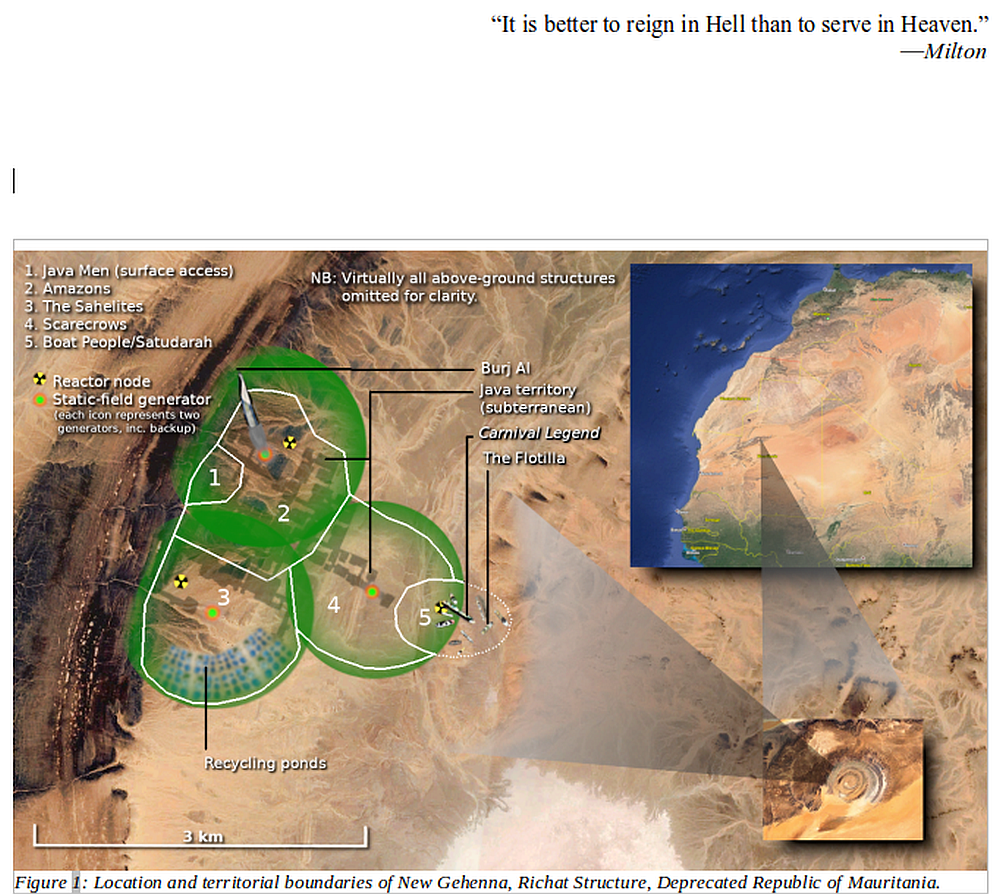
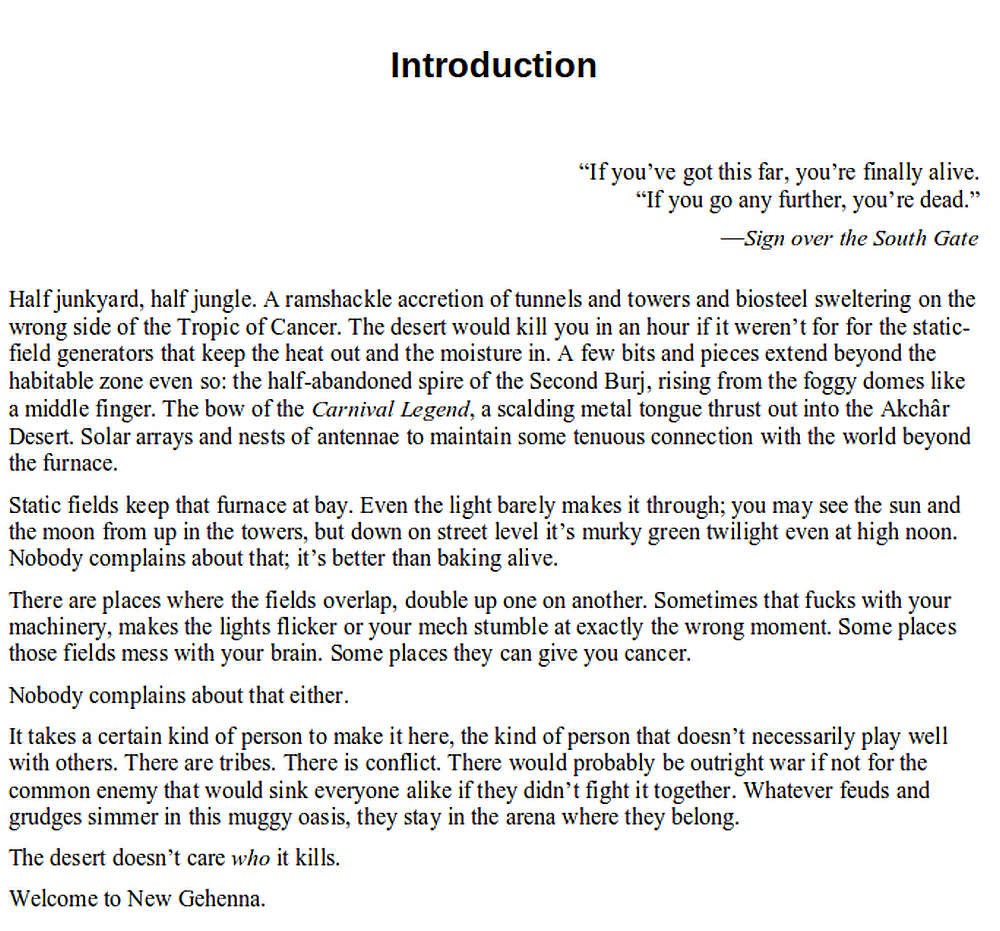
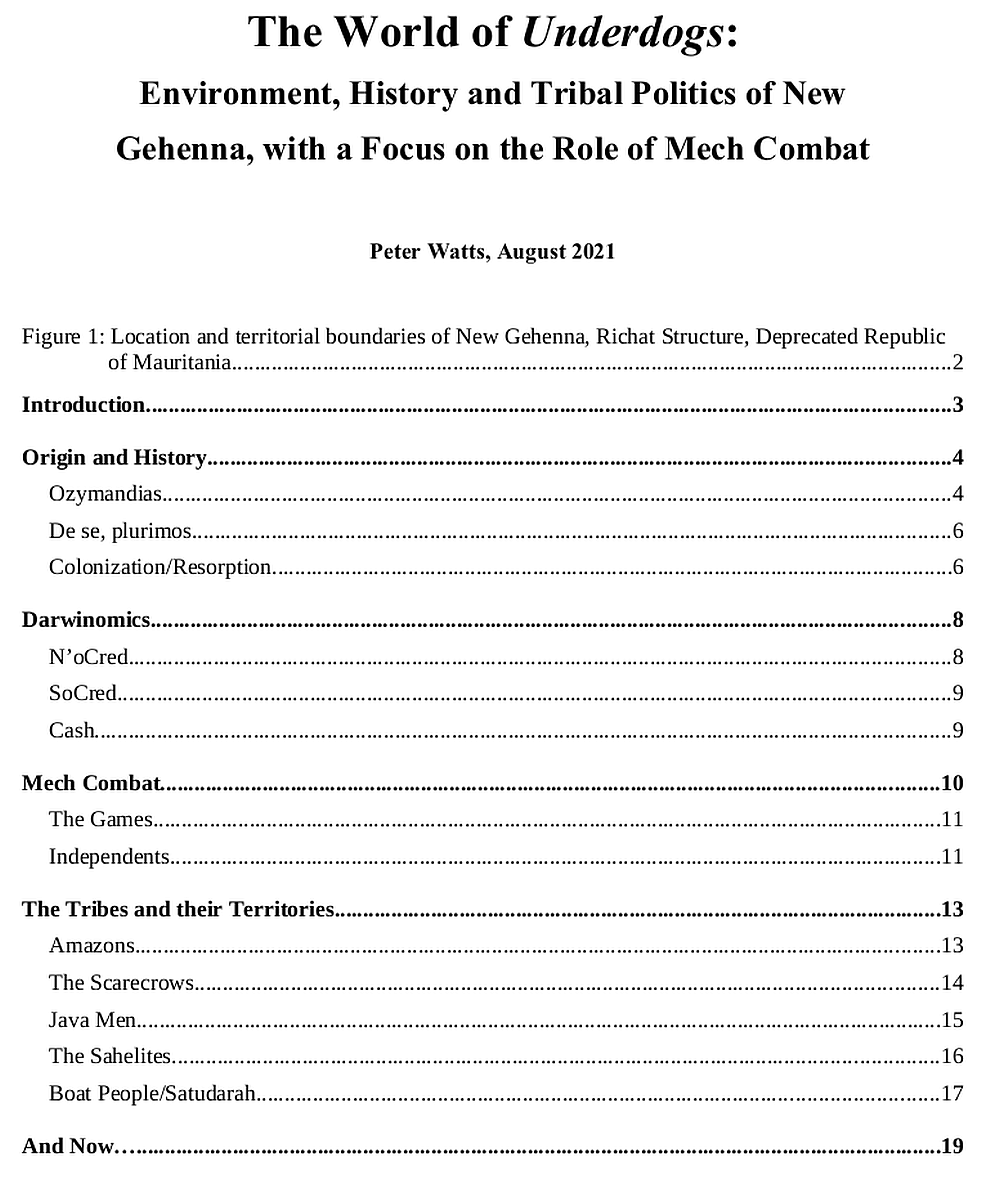
So I wrote historical backgrounds and physical infrastructure. I wrote a timeline explaining how we got there from here, how New Gehenna (as I called it then) ended up as the beating heart of the global mech-fighting world. I developed “Tribes”—half gang, half gummint—with their own grudges and ideologies: The Satudarah, the Java men, the Sahelites and the Scarecrows and the Amazons. I gave them territories, control over various vital resources. I built specific characters like I was crafting a D&D party, NPCs the player might encounter both in and out of the ring. I fleshed out a couple of bros from the Basics, the lower-class part of London where surplus Humanity all made do on UBI. Economic and political systems. I wrote thousands of words, forty, fifty single-spaced pages of this stuff.
To give you a taste, this is how one of my backgrounders started off as usual, click to embiggen):
And here’s one of my Tables of Contents:
Now you know what I was doing when I wasn’t writing Omniscience.
*
I don’t know how much of this survived. It’s in the nature of the biz that the story changes to serve the game. I’m told the backstory I developed remains foundational to Underdogs; its bones inform what you experience whether they appear explicitly or not. But much has changed: the city is New Brakka, not New Gehenna. The static fields now serve to jam Big Sys, not to keep out the desert heat. (The desert in this world isn’t even all that hot any more, thanks to various geoengineering megaprojects that went sideways.) I think I see hints of my Tribes and territories as Rigg and King prowl the backstreets: references to “caveman territory”, or to bits of infrastructure I inserted to give the factions something to fight over. Not having even breached the city gates I don’t know how many of those Easter eggs might be waiting for me, but assuming I can get out of the KillBox I’m definitely gonna be keeping an eye out. (I think maybe the Spire survived in some form. I’m really, really hoping the Pink Widow did too, but I doubt it.)
Doesn’t really matter, though. I love the fact that Underdogs has a fairly deep backstory, and I’m honored to have had even a small part in building it; you could write entire novels set in New Brakka. But this game… this game is definitely not plot driven. It is pure first-person adrenaline dust-up, with a relentless grim and beautiful grotto-punk aesthetic (yes, yet another kind of -punk; deal with it) that saturates everything from the soundtrack to the voice acting to the interactive cut-scenes. I admit I was skeptical of those cut-scenes at first; having steeped myself in Bioshock and Skyrim and The Last Of Us all these years, were comic-book cut-outs really going to do it for me?
But yes. Yes they totally did. Don’t take my word for it: check out the Youtube reviews. Go over to Underdog’s Steam page, where the hundreds of user reviews are “Overwhelmingly Positive”. The only real complaint people have about this game is that there isn’t more of it.
This game was not made for VR: VR was made for this game.
Most of you remain in pancake mode. VR is too expensive, or you get nauseous, or you’ve erroneously come to equate “VR” with “Oculus” and you (quite rightly) don’t want anything to do with the fucking Zuckerborg. But those of you who do have headsets should definitely get this game. Then you should talk to all those other people, show them that the Valve Index is actually superior to the Oculus in a number of ways (and it supports Linux!), and introduce them to Underdogs. Show them what VR can be, when you’re not puking all over the floor because you can’t get out of smooth-motion mode and no one told you about Natural Locomotion. Underdogs is the best ambassador for VR since, well, RacketNX. It deserves to be a massive hit.
Now I’m gonna take another run at that boss. I’ll let you know when I break out.